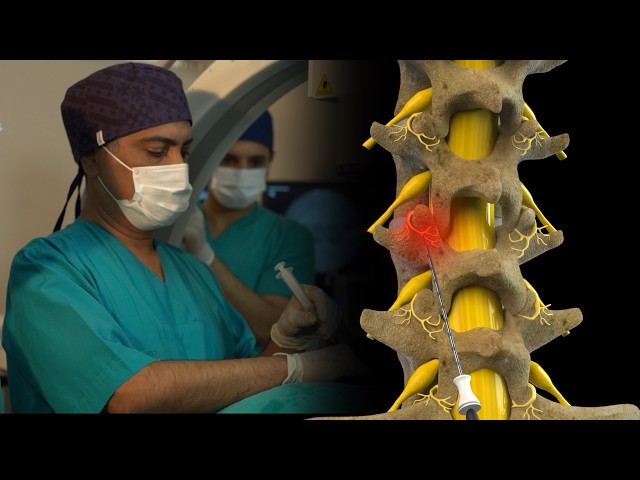
Lumbar facet joint osteoarthritis, also known as facet syndrome, is a common cause of lower-back pain. The lower back contains five vertebrae, which are linked at the back by facet joints. These joints guide and support movement of the spine.
Facet syndrome is most often related to ageing, but it can also affect younger people who perform heavy physical work. Age and repeated strain can cause wear in the facet joints, leading to lower-back pain. Typical symptoms include morning stiffness and pain that becomes worse when bending backwards. Pain can reduce activity, while inactivity may in turn contribute to a cycle of stiffness and reduced movement.
At our centre, the first step in treating lumbar facet joint pain is to relieve the pain. Facet joint denervation is the most effective method used for this purpose. Patient education is equally important: patients receive an appropriate exercise programme and guidance on habits that can help protect the spine.
Radiofrequency Treatment
The medial branch nerves carry pain signals from the facet joints. Radiofrequency denervation may be offered when a diagnostic facet joint injection or block has provided relief. Under imaging guidance, a computer-controlled device applies carefully controlled heat to these nerves to interrupt the pain signals from the affected joints.
Meticulously Performed Lumbar Facet Joint Osteoarthritis Treatments
No extensive preparation is required. The procedure is performed under local anaesthesia and takes about 20–25 minutes. Patients are usually able to go home after approximately 30 minutes of observation and are advised to rest for two days. Side effects are very rare; serious complications such as bleeding or nerve damage are almost never seen, and infection is extremely uncommon.
Appointments & practical information
How do I book an appointment?
You can send your appointment request via WhatsApp, by phone or through the contact form. Briefly describing your complaint and the times that suit you speeds things up; we respond as quickly as possible.
What should you bring to the consultation?
If available, bring your recent MRI and CT images, previous test and surgery reports, and a list of the medication you take regularly. This makes the assessment considerably easier.
What happens at the first consultation?
We listen to your complaints and history, perform a neurological examination and review your existing images together. Treatment options are then planned with you, taking your expectations and lifestyle into account.
Second opinion
If you have been diagnosed or advised to have surgery elsewhere, you can book an appointment for a second opinion with your existing images and reports.
Reach out for your questions and appointment requests. We reply as soon as possible.
The small joints at the back of our spine that connect the vertebrae to one another are called "facet joints". The wearing down of these joints over time, the deterioration of their cartilage structure and the thickening of the surrounding ligaments is what we call lumbar calcification, or Facet Syndrome. This condition is a source of chronic pain that restricts the mobility of the lower back.
What Are the Symptoms of Lumbar Osteoarthritis (Facet Disease)?
The most prominent complaint is morning stiffness. It is a severe pain felt in the back of the lower back that increases when bending backward or turning to the right and left. The pain is usually in the lower back region but can radiate to the buttock and sometimes to the back of the upper leg. When the patient stands or sits for a long time, they feel a great heaviness and aching in the lower back.
What Causes Lumbar Osteoarthritis (Facet Disease)?
The primary cause is age. However, being overweight, doing uncontrolled sports, working in heavy physical jobs, previous back traumas, and the loss of disc height due to a lumbar disc herniation increase the load on the facet joints, accelerating the osteoarthritis.
What Happens If Lumbar Osteoarthritis (Facet Disease) Is Not Treated?
When left untreated, the osteoarthritis in the joints increases and bony protrusions (osteophytes) form. This condition can lead to canal stenosis. In addition, because of the pain, the patient stops moving; this in turn leads to weakening of the back muscles and leaves the spine completely without support, thereby causing a vicious cycle.
Is Non-Surgical Treatment of Lumbar Osteoarthritis (Facet Disease) Possible?
It is absolutely possible, and in fact the first option is non-surgical methods. With radiofrequency denervation, facet joint blocks, and physical therapy methods, more than 90% of our patients are able to return to a comfortable life without the need for surgery.
Is the Stiffness and Pain Felt in the Lower Back in the Mornings a Sign of Osteoarthritis?
Yes, this is the most classic symptom of facet syndrome. That "rusting sensation" felt upon waking in the morning, which eases within 15-20 minutes as you move, indicates osteoarthritis in the joints. The stagnation of the joint fluid causes this stiffness; the pain decreases with movement.
In Which Cases Does Lumbar Osteoarthritis (Facet Disease) Require Surgery?
If the osteoarthritis has progressed so far that the bony structures are compressing the nerves and causing serious loss of strength (risk of paralysis), or if it is accompanied by "spinal slippage" (spondylolisthesis), surgical stabilization (screw/plate) operations may be necessary. However, in osteoarthritis with only a complaint of pain, surgery is rarely the first choice.
Does Injection Treatment Offer a Permanent Solution for Lumbar Osteoarthritis (Facet Disease)?
Because radiofrequency injection treatment (denervation) deactivates the nerve fibers that carry the pain, it offers lasting relief for up to 2 years, and even longer in some patients. During this period, in patients who lose weight and strengthen their lower back, the state of well-being lasts much longer.
Does Lumbar Osteoarthritis (Facet Joint Disease) Cause a Lumbar Herniated Disc?
Yes, it is directly related. Arthritic joints disrupt the spine's load balance. This imbalance places more load on the discs between the vertebrae and sets the stage for the disc to wear out prematurely and herniate.
Is Exercise Good for Lumbar Osteoarthritis (Facet Joint Disease)?
Exercise is an integral part of the treatment. Especially pilates, swimming and stretching movements that strengthen the abdominal and back muscles reduce the load on the facet joints and increase the success of the treatment. However, uncontrolled exercise should be avoided during painful periods.
Does Lumbar Osteoarthritis (Facet Joint Disease) Cause Pain Radiating to the Legs?
Yes, but this differs from the pain of a herniated disc. We call this "referred pain." Pain originating from the facet joints can spread to the back of the thigh and down to the level of the knee. Pain that goes all the way down to the toes, on the other hand, generally suggests that a herniated disc accompanies the osteoarthritis.
Which Is More Effective in Diagnosing Lumbar Osteoarthritis (Facet Joint Disease), MRI or CT?
MRI is very valuable for visualizing cartilage structures, soft tissue and nerve compression. However, to see the effects of the osteoarthritis on the bone and to measure the amount of calcification down to the millimeter, Computed Tomography (CT) is sometimes superior in diagnosing osteoarthritis.
How Are Facet Joint Injection and Radiofrequency Denervation Performed?
Both procedures are performed in an operating room setting under fluoroscopy (live X-ray) guidance. The targeted joint points are accessed with special needles. In the injection, medication is delivered to the area; in the radiofrequency method, heat is applied through the tip of the needle to block the nerve ending that carries the joint's pain sensation to the brain.
What Is the Success Rate of Facet Joint Denervation with Radiofrequency?
In patients who have been correctly diagnosed (with a test block performed), the success rate is between 80% and 90%. It is a comfortable procedure that instantly improves the patient's quality of life.
How Is Facet Joint Denervation with Radiofrequency Performed?
The patient is placed face down and the area to be treated is sterilized. The joint is visualized precisely with fluoroscopy. After the needle is placed, test currents are given to confirm that we are at the correct point (the patient feels a slight tingling). The procedure is then completed with a safe application of heat.
Is There a Risk of Paralysis During the Facet Joint Denervation with Radiofrequency Procedure?
No. The needles used during the procedure and the applied radiofrequency current are directed away from the main nerves that move the legs and only onto the thin sensory nerves that carry the joint pain. Because it is performed under fluoroscopy guidance, a risk of paralysis is not medically expected.
Is the Facet Joint Denervation with Radiofrequency Procedure Performed under General Anesthesia or Local Anesthesia?
The procedure is performed entirely under local anesthesia. The patient being awake during the procedure and responding to the test currents keeps safety at the highest level.
Is Rest Required after Facet Joint Denervation with Radiofrequency, and When Can I Return to Work?
Resting at home on the day of the procedure is sufficient. Because there are no stitches or incisions, our patients can return to their normal working lives the next day.
What Is the Diagnostic Block (Test Needle) Method in Diagnosing Facet Joint Pain?
This is the most important step. Before radiofrequency, a very small amount of local anesthetic is injected into the joint to test whether the pain originates from that joint. If the pain completely disappears for a while, it is confirmed that the radiofrequency will be successful.
Does Facet Joint Denervation with Radiofrequency Treatment Have Any Harmful Effects?
No, no foreign substance or harmful radiation is introduced into the body. Only a heat effect is created on the targeted nerve ending. It causes no harm to other organs or tissues.
What Are the Side Effects of Facet Joint Denervation with Radiofrequency Treatment?
Rarely, there may be mild bruising lasting 2-3 days at the application site or tenderness related to the needle insertion. In some patients, a slight increase in pain (rebound pain) may be seen during the first few days after the procedure, but this is temporary.
When Does Facet Joint Denervation with Radiofrequency Treatment Take Effect?
Some patients feel relief immediately, but it may take 2 to 3 weeks for the procedure to take full effect and for the nerve healing to be completed.
What Are the Risks of Facet Joint Denervation with Radiofrequency Treatment?
Infection and local bleeding are, as with any interventional procedure, a very low probability (below 1%). When performed by a neurosurgeon under fluoroscopy guidance, it does not carry a serious risk.
How Long Does Facet Joint Denervation with Radiofrequency Treatment Take?
Depending on the number of levels to be treated, the procedure is generally completed within 20-40 minutes.
Who Performs Facet Joint Denervation with Radiofrequency Treatment?
It should be performed by Neurosurgery specialists who have a command of spinal anatomy or by Algology (Pain) specialists.
What Is the Difference between Facet Joint Denervation with Radiofrequency and Laser Treatment?
Laser is generally used to "vaporize the inside of the herniated disc," whereas radiofrequency is used to "block the joint pain nerves." The two address different problems.
Does Private Health Insurance Cover Facet Joint Denervation with Radiofrequency Treatment?
Many private health insurers cover these procedures according to the policy when a report of medical necessity is provided.
What Type of Anesthesia Is Used for Facet Joint Denervation with Radiofrequency?
Only local numbing is applied. The patient is in communication with the surgeon throughout the entire process.
Can I Be Discharged the Same Day after Facet Joint Denervation with Radiofrequency Treatment?
Yes, you can be discharged and walk out 1-2 hours after the procedure is finished.
Is Rest Required after Facet Joint Denervation with Radiofrequency Treatment?
Avoiding heavy physical activity for 24-48 hours is sufficient. Absolute bed rest is not required.
Is Facet Joint Denervation with Radiofrequency Treatment Performed in the Operating Room or the Outpatient Clinic?
It must absolutely be performed under operating room conditions, with sterilization and under the control of a fluoroscopy device. Outpatient clinic conditions are not suitable for this procedure.
Is Burning the Nerves with Radiofrequency Facet Joint Denervation Dangerous? Is There a Risk of Paralysis?
Although the term "burning" frightens patients, the procedure only "silences" the thin branches that transmit pain. The motor nerves are preserved, so there is no risk of paralysis.
Does the Heat of Radiofrequency Facet Joint Denervation Shrink the Herniation, or Does It Only Relieve the Pain?
Facet radiofrequency only relieves the joint pain. If it is applied inside the disc (Nucleoplasty), then its aim is to shrink the herniation.
Does Radiofrequency Facet Joint Denervation Leave Any Permanent Damage?
No, it does not leave any unwanted permanent damage to the anatomy of the spine or to the nervous system.
During the Radiofrequency Facet Joint Denervation Procedure, Are We Put to Sleep? Is It a Painful Procedure?
You are not put to sleep. Because the needle entry sites are numbed, no unbearable pain is felt. Only when the needle reaches the joint is a brief sensation of pressure felt.
How Many Minutes Does the Radiofrequency Facet Joint Denervation Procedure Take? Can I Go Home Right Away?
It takes an average of 30 minutes. After 2 hours of observation, you can go home right away.
Where Exactly Does the Radiofrequency Facet Joint Denervation Needle Go In? Are Stitches Placed?
It is inserted over the facet joints in the lower back, into the safe tunnels through which the nerve passes. There are no stitches; the entry hole closes quickly on its own.
Is Radiofrequency Facet Joint Denervation Applied Inside the Herniation or to the Nerve Roots?
It depends on the patient's complaint. For disc-related pain it is applied inside the disc (nucleoplasty), for calcification pain to the joint nerve, and for leg or arm pain to the nerve root (pulsed RF).
Which Is More Effective: Laser Treatment for Herniation or Radiofrequency Facet Joint Denervation?
These two methods serve different purposes. For shrinking a herniation, the laser is generally more effective; for relieving nerve pain and arthritic pain, radiofrequency is generally more effective.
Physical Therapy Did Not Work; Can Radiofrequency Facet Joint Denervation Be a Definitive Solution?
In patients with facet syndrome who do not get results from physical therapy, radiofrequency is our most powerful alternative that provides a definitive result, because it relieves the pain at its source.